Alaskan Alpine Treks


avatar

Owner and guide Carl Donohue, Flying over Chittistone Pass.


Shopping For Gear?


Add to Technorati Favorites


AddThis Social Bookmark Button


Add to My AOL


Add Alaskan Alpine Treks Blog to Newsburst from CNET News.com


Translate this page.


logo

Image of the Month – Mt Sanford in the Morning

August 31st, 2010

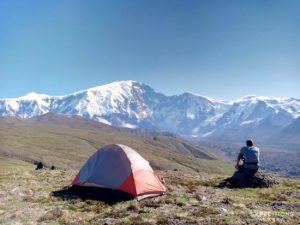
Hiker viewing Mt. Sanford, Wrangell - St. Elias National Park, Alaska. Please click on the thumbnail to view a larger virsion of the photo.

Hey Folks,

Mount Sanford in early morning light. What a gorgeous morning!

Fall is such a great time for photography. The light has a quality that is tangibly different to any other time of year, and a cool clear morning is a real treat for a photographer.

This view of Mt Sanford, 6th highest peak in the US and 2nd highest in the Wrangell Mountains, is a great place to spend a morning. Here’s hoping for many more like this.

Cheers

Carl

line

Skookum Volcano Trail

August 21st, 2010
View from Skookum Volcano Trail.

A view from the Skookum Volcano Trail, a nice hike in Wrangell - St. Elias National Park and Preserve, near the old mining town of Nabesna. Please click on the thumbnail to view a larger version of the photo.

Hey Folks,

Here’s a quick shot from a recent hike up around Nabesna. I walked the Skookum Volcano trail – some great views out over this part of Wrangell – St. Elias National Park. Fall colors are right around the corner, and up high like this, the blueberry is already turning red.

The mountains up around this pass are amazing – really some great shapes and patterns in those rocks. I need to get back up there asap and shoot it some more.

The northern side of the park receives far fewer visitors than the south side, on the McCarthy Road, though I think the dayhiking and the photography is probably better on the north side. If the weather is clear, some of the best views in the park can be found off the Nabesna Road. Fall colors, too, can be intense, almost overwhelming, in late August/early September. And, I generally see more wildlife in this section of the park than I do along the McCarthy Road, though wildlife viewing is almost always hit and miss anywhere.

Next summer I’m going to be doing a little more backpacking in the area, and will offer some newer trips in this region, particularly a few shorter, easier hikes. As well, some of those walks don’t involve bush flights in and out of the backcountry, so they’ll be quite a bit cheaper as well. Stay tuned to the website for more information on those in October.

Those are the Mentasta Mountains in the background.

Cheers

Carl

line

Monahan Creek, Iceberg to Bremner

August 9th, 2010
A hiker takes in the view in the Chugach Mountains, Iceberg Lake to Bremner Mines or Seven Pass route, Wrangell - St. Elias National Park and Preserve, Alaska.

Charlie Sprayregen takes in the view in the Chugach Mountains, Iceberg Lake to Bremner Mines or Seven Pass route, Wrangell - St. Elias National Park and Preserve, Alaska. Please click the thumbnail to view a larger version of the photo.

Hey Folks,

Here’s a photo from our trip last week to Wrangell – St. Elias National Park and Preserve. Charlie was gracious enough to pose for me here on this little ledge, one gorgeous morning on the Iceberg Lake to Bremner Mines trip.

We were so lucky on this trip to get some nice weather; it’s not been a fantastic summer, weather-wise, so far, yet we had more sunny days than not on our hike. Charlie and his family, from Chicago, had somewhat of a mad rush to get here, flying directly from Chicago to Anchorage to McCarthy to Iceberg Lake; including a short, mad dash thru the streets of Anchorage to replenish gear when, upon arrival in Anchorage, they learned Charlie’s backpack hadn’t made the flight, and was still in Chicago. The bedlam settled when we arrived, after many hours of travel (for Charlie and family) at Iceberg Lake, on a gorgeous sunny evening. …. Read the rest of this entry » »

line

Image of the Month – The Goat Trail

July 31st, 2010
Sunset over the Chitistone Valley and the University Peaks, Wrangell - St. Elias National Park and Preserve, Alaska.

Sunset over the Chitistone Valley and the University Peaks, Wrangell - St. Elias National Park and Preserve, Alaska. Please click the thumbnail to view a larger version of the photo.

Hey Folks,

And the Image of the Month for August 2010 is a photo of sunset over the University Peaks, just south of the Chitistone River. We’d backpacked down the Chitistone Canyon all day, set up camp after crossing the Goat Trail, had a GREAT dinner with superb views of Mount Bona (16 421′ high) and the University Range, and the light kept getting better and better. I’d long wanted to hike down this little creek to a plateau above the Chitistone River and shoot sunset there, and knew this would be a great opportunity to do so.

I couldn’t convince any of the hikers in our group to join for me the evening trek (2 miles one way), so I grabbed my camera gear after we’d finished dinner, and set out. Though this scene wasn’t my intended final destination, I loved the combination of clouds, deep, steep canyon walls, and the warm light hitting the distant unnamed mountain. I stopped and took a few photos before continuing on my way down to the plateau.

When shooting a scene such as this, with high contrast between the shaded depths of the steep canyon and the bright clouds and distant peaks (Mount Bona) I use either a Split Density filter or take multiple images of differing exposures and blend them together in the computer later. This image I used 2 split density filters, a 2-stop and a 3-stop. Handholding 2 filters is hard; handholding them when you don’t want them to align symmetrically is really hard. Lesson #1 – carry a Cokin filter holder.

The Goat Trail is the first route I ever hiked in Wrangell – St. Elias National Park and Preserve, and is always a welcome treat for me to return to. This one was a night I’ll remember for along time. I returned to our high camp at around midnight. What a fantastic evening.

Cheers

Carl

line

Brooks Range, ANWR

July 25th, 2010
A waterfall in a small stream near the Upper Marsh Fork River, Brooks Range mountains, Arctic National Wildlife Refuge (ANWR), Alaska.

A waterfall in a small stream near the Upper Marsh Fork River, Brooks Range mountains, Arctic National Wildlife Refuge (ANWR), Alaska. Please click the thumbnail to view a larger version of the photo.

Hey folks,

Here’s another image from our recent trip to the Arctic National Wildlife Refuge. this trip was simply awesome. A great group of folks, from Florida, Colorado and Washington, who all carried the most ingredient for a great trip – great attitude. Everyone really clicked, and we had a ton of fun; lots of laughs and good times.

This photo was taken on our 1st night out; we camped on a big alluvial fan that comes out of the mountains, on the west side of the Marsh Fork River. After dinner we hiked up the stream and climbed a small ridgeline for some amazing views back south, to the heart of the mountain range and the contintental divide. The light was really happening, and I was pretty happy with a few of the images I made.

Afterward, the light began to fade and we hiked back toward camp. The sun began to poke through again, for one great show, and I saw this little miniature waterfall that I knew would make a great foreground. The light show only lasted a couple of minutes before high clouds to the north dulled the glow. By the time I’d rearranged this for a horizontal composition, the light was noticeably dimmer on the distant peak. Minutes later, the glow was gone.

This image was taken around 2:00am. Photography in the arctic summer is a challenge, shifting ones mental and body clock to the wee hours of the “night“, to capture the nicest light. Oftentimes I’ll shoot til later and go to bed around 4:00am, or later. They don’t call this the land of the midnight sun for nothing.

Here’s a photo below of Steve, from Colorado, shooting the following morning, around 4:00am. We’d gone to bed, got some rest, and then the sun came around the corner of the range to the north, and lit up the valley. I was up immediately, woke Steve, and we shot for a couple of hours before going back to bed. It’s an absolutely incredible experience to watch the mountains here, in the quiet hours of the “dawn“, and feel the arctic air start to warm. Magical doesn’t describe the experience.

Steve shooting at Dawn, ANWR.

Steve shooting the Marsh Fork River, Brooks Range, ANWR.

What a blast we had! To view some of Steve’s fantasic work from this trip, visit his gallery here. He made some amazing images.

It’s really nice to have another serious photographer along on a trip like this, even the trip is not promoted as a ‘photography tour’ at all. Steve inspired and motivated me to work harder and longer, and to look more closely than I otherwise might. I learnt a lot from watching him shoot.

Cheers

Carl

line

Usain Bolt in Wrangell – St. Elias National Park.

July 22nd, 2010

Hey Folks,

Watch this clip, destined to become a classic, to see a brief, sudden and welcome appearance by the great Usain Bolt; Usain pops up in the video and shows his classic ‘bow and arrow’ pose, while simultaneously unveiling some gorgeous new footwear. I managed to grab a few seconds of him on video before he raced out of sight.

I was trying to grab some footage of the Chitistone Valley in heavy fog, from the “Wolverine” landing strip, when Usain appeared. I believe this is the first time he’s visited Wrangell – St. Elias National Park and Preserve, indeed Alaska itself. I’m sure he’ll make another appearance or 2 before the end of this season.

Cheers

Carl

line

Pacific Loon photo, ANWR.

July 17th, 2010
A pacific loon swimming on a pond on the coastal plain, in the Arctic National Wildlife Refuge, ANWR, Alaska. Waterfowl migrate thousands of miles to nest and breed and feed on the rich coastal plain of the Refuge in summer. (Gavia pacifica)

A pacific loon swimming on a pond on the coastal plain, in the Arctic National Wildlife Refuge, ANWR, Alaska. Waterfowl migrate thousands of miles to nest and breed and feed on the rich coastal plain of the Refuge in summer. (Gavia pacifica) Please click on the thumbnail to view a larger version of the photo.

Hey Folks,

A Pacific Loon, photographed on a pond on the coastal plain of the Arctic National Wildlife Refuge. Taken at the end of our recent trip to ANWR, floating down the Canning River to the Arctic Ocean.

The final evening provided some great light, and some gorgeous Pacific loons (Gavia pacifica) to photograph. Loons are one of my favorite birds, really a beautiful bird, and it’s always a treat to photograph them.

This year we were fortunate to see Common loons, Red-throated loon and Pacific loons, but not the less common Yellow-billed loon. Maybe next summer we’ll be treated to the awesome foursome!

I’ll try to post something soon from our Skolai – Wolverine hike . Until then, I hope you enjoy this Pacific loon photo.

Cheers

Carl

line

Horseplay on Aufeis

July 11th, 2010
Hikers enjoying horseplay of aufeis, Canning River, Arctic National Wildlife Refuge (ANWR), Alaska.

Hikers enjoying horseplay of aufeis, Canning River, Arctic National Wildlife Refuge (ANWR), Alaska. Please click on the thumbnail to view a larger version of the photo.

Hey Folks,

Here’s a shot from our recent trip down the Canning River in the Arctic National Wildlife Refuge. You can see we had a lot of fun, great spirits, great weather, spectacular scenery and a great, great group of folks. What more could we ask for?

Aufeis is a German word to refer to overflow ice, that typically melts out during the summer, and re-accumulates in the winter. It’s pretty common along most waterways in the Arctic. Here it provided a platform for some tom-foolery. Good fun all the way around.

Minutes earlier we’d been watching a mature bull caribou wander along the ridges of Aufeis; caribou often hang out on the ice to keep cool and stay away from the oft-present mosquitoes during summer’s brief madness. Fortunately this year the bugs were largely gone by the time of our trip, and we all had a great time with no insanity from the mosquitoes.

Cheers

Carl

line

Image of the Month – Rock lake, Wrangell St. Elias

June 26th, 2010

Rock lake, sunset, Wrangell St. Elias National Park and Preserve. Please click on the thumbnail to view a larger version of the photo.

Hey Folks,

It’s summer time, and I don’t have much time to blog – but I’ll try to keep up with the Image of the Month. Here’s one from the north side of Wrangell – St. Elias National Park and Preserve. Taken from Rock lake, at sunset, the light on the distant Wrangell Mountains was gorgeous.

Thanks.

Cheers

Carl.

line

Image of the Month – Hiking at Skolai Pass

June 1st, 2010
Backpackers hiking the tundra at Hole in the Wall.

Hole in the Wall, near Skolai Pass, is a great place to explore. Wrangell St. Elias National Park and Preserve, Alaska. Please click on the thumbnail to view a larger version of the photo.

Hey Folks,

Photo of the Month for June, 2010, is this photo of some folks hiking up at Hole in the Wall, near Skolai Pass, Wrangell – St. Elias National Park and Preserve. I love the sense of scale this photo gives for the peak in the background. This is one of the peaks known as the 7 fingers, glacier-capped outcroppings towering above the tundra. Hole in the Wall is a classic old glacial formation, and a great place to walk and explore; I’ve spend many a day wandering around on the moraine, awestruck at the magnificent jagged cliff faces soaring above me.

This trip was a few years ago, and we had a grand time. The weather was, as you see here, unbeatable, and we all enjoyed the week we spent in Skolai Pass. We camped on an open ridge above the pass, before heading south to Chitistone Pass, where we camped and enjoyed the scenery. From Chitistone Pass, we ventured down to Russell Glacier, over into Chitistone Valley, and checked out the Goat Trail. Then we made out way back along the floor of Skolai Pass.

The big boulders in the foreground are called erratics; a piece of rock that differs from the size and type of rock native to the area in which it rests. They’re moved into place, carried by glacial ice , and deposited when the ice retreats. Sometimes they’re moved hundreds of miles by advancing glaciers; at Hole in the Wall, they were moved a mile or so. But a number of these large boulders technically aren’t really erratics, as they have fallen from the cliffs above. Massive, some of them are the size of a small house. The geology here is incredible.

I’m looking forward to getting back up to Skolai Pass this summer; it’s just one of “those” places that I can go back to every year and love it. It’s kinda like going home each summer. Each trip brings both new vistas and intimate views of the nooks and crannies, the secrets of Skolai. At the same time, seeing the features like Hole in the Wall and Russell Glacier again is a welcome treat. I love it.

We’ll be up at Skolai mid july this year, and I can’t WAIT!

Cheers

Carl

line